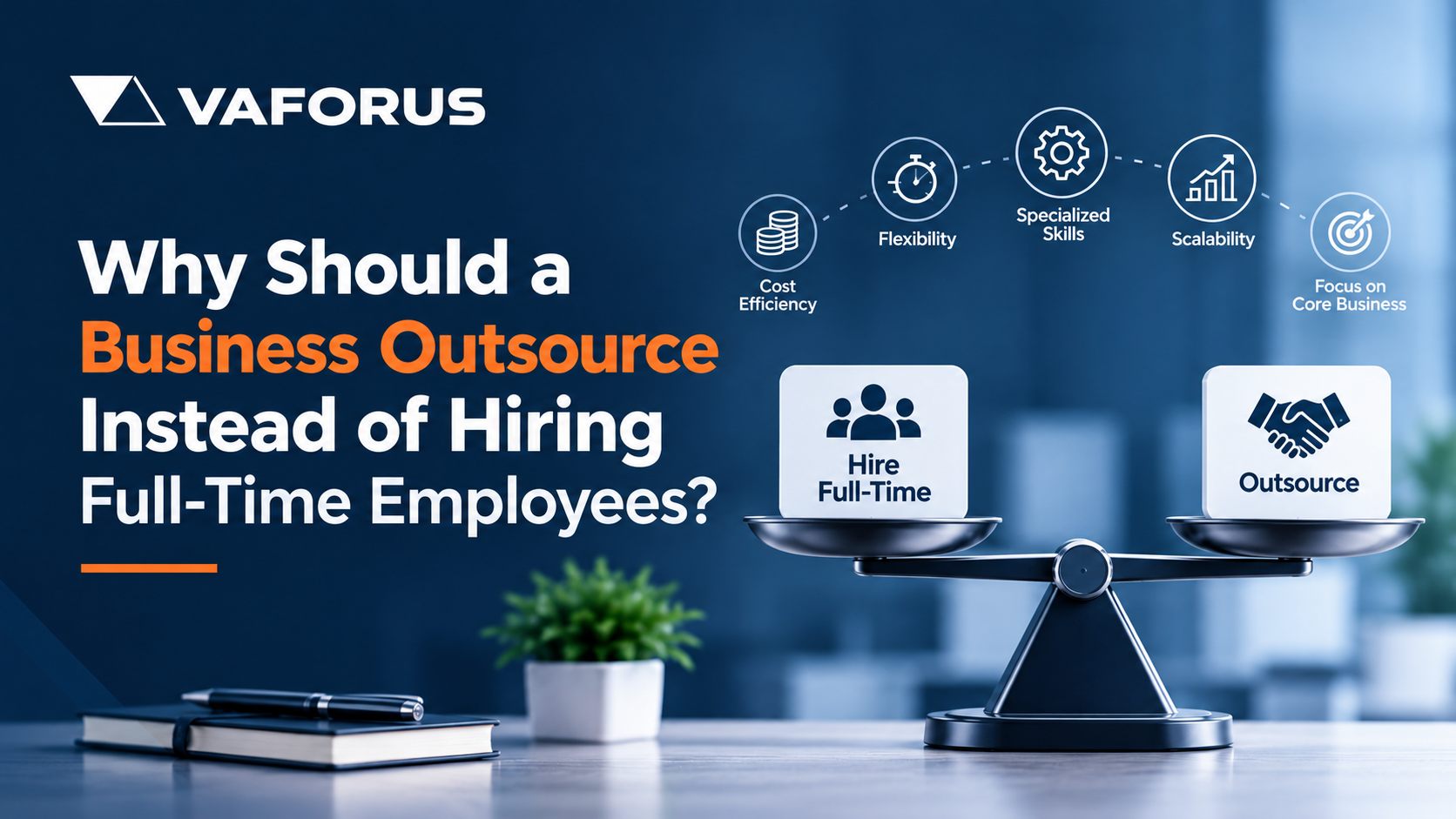
Short answer: A business should outsource instead of hiring full-time when the work is variable, specialized, or urgent, or when the role isn't proven yet. Hire full-time when the work is core to your strategy, steady week after week, and likely to exist for years. If you're unsure, outsource one function first and hire once the need is clear.
Key takeaways
- Outsource when workload swings, the skill is specialized, or you need help faster than a hiring cycle allows.
- Hire for steady, long-term roles that shape your strategy or protect your IP.
- Compare the fully loaded cost of an employee with a service fee for the same scope, not salary alone.
- Many growing companies use a hybrid model: a small team in-house plus outsourced support.
Every growing business reaches the same moment. The work is piling up, the team is stretched, and someone says, "We need to hire." But a full-time hire is a long and expensive commitment, and it isn't always the right fix. Knowing when to outsource, and when not to, can save you months of lost time and thousands of dollars in payroll you didn't need.
This guide covers the signs it's time to outsource, when hiring is the better choice, how the costs compare, and how to start without building another team.
What does it mean to outsource instead of hiring full-time?
Outsourcing means paying an outside company, agency, or specialist to handle a defined piece of work instead of adding an employee to your payroll. You pay for the results or the hours, not for salary, benefits, equipment, and management time.
Common arrangements include a freelancer for a one-off task, a managed outsourcing partner that runs a function for you, and a dedicated remote team that works as an extension of yours. Hiring a full-time employee means a long-term commitment: payroll taxes, benefits, onboarding, and ongoing management.
Neither option is better by default. The right choice depends on the work itself. For a deeper look at price and trade-offs, see our guide to in-house vs outsourcing.
Outsourcing vs hiring full-time: quick comparison
- Workload: Outsource when it is variable or uncertain. Hire an employee when it is steady and predictable.
- Speed to start: Outsourcing takes days to a few weeks. Hiring an employee takes weeks to months, plus notice periods.
- Cost structure: Outsourcing is a flexible fee tied to scope. An employee is a fixed salary plus taxes, benefits, and equipment.
- Expertise: Outsourcing gives you specialist expertise on demand. An employee gives you one person's skill set.
- Control: Outsourcing is shared and set by scope and KPIs. An employee is direct, day-to-day control.
- Scalability: Outsourcing scales up or down quickly. With an employee it is slower, and hiring and layoffs are costly.
- Commitment: Outsourcing is short or flexible. An employee is a long-term commitment.
- Best for: Outsource support, specialist, or project work. Hire an employee for strategy, IP, and culture-defining roles.
Use the table as a starting point. The signs below show where your business sits on each row.
6 signs it's time to outsource instead of hiring
These six signs show when to outsource instead of hiring. If two or more describe your business, it's worth a serious look.
1. Your workload rises and falls
Seasonal spikes, campaign launches, and product releases create busy periods followed by quiet ones. An employee costs the same in a slow month as in a peak month. An outsourced team can scale up and down with demand. If your busiest weeks need three people and your slowest need one, outsourcing the overflow makes more sense than hiring for the peak.
2. You need specialized skills you can't justify hiring for
Web development, SEO, email marketing, cybersecurity, and accounting each demand deep expertise. Hiring a salaried specialist for every one of them is unrealistic for most small teams. Outsourcing gives you specialized skills only for as long as you need them, without building a department.
3. You need help faster than a hiring cycle allows
SHRM's recruiting benchmarks put the median time to fill a nonexecutive role at about 39 days, and that's before notice periods and onboarding. If deadlines are slipping today, a new hire may not help for months. Outsourcing can start work in days or weeks, and it can bridge the gap while you recruit.
4. The role isn't clearly defined or permanent yet
If you can't write a job description you'd stand behind, hiring is premature. A wrong hire is costly, and turnover means paying for recruiting and onboarding twice. Outsource the work for a few months, learn what the role really needs, then decide whether it should become a permanent position.
5. Founders and key staff are stuck in non-core work
When a founder handles bookkeeping or a senior developer handles IT support, you're paying premium rates for low-value work. Ask one question: does this task create our competitive advantage? If the answer is no, it's a strong candidate to outsource, and your team can focus on the core work only they can do.
6. Hiring keeps failing or keeps turning over
Candidates don't meet the experience you need, start dates keep slipping, or the same vacancy reopens every few months. Outsourcing opens up a wider talent pool, including global remote talent, so you aren't limited to what your local market offers at your budget.
When hiring full-time is the better choice
Knowing when not to outsource matters as much as knowing when to outsource. Hiring is usually the right call in these cases:
- The work is core to your business. Your product, proprietary methods, and strategy are what make you different. Keep them in-house.
- The workload is steady and the role is clear. If you'll need the same output every week for years, an employee is often the better value.
- The role needs deep company knowledge or builds culture. Leadership roles and key client relationships are hard to delegate.
- Sensitive data or IP is involved. Without strong safeguards, keep it internal.
- Physical presence is required. Operating machinery or handling inventory can't be done remotely.
You also shouldn't outsource work you haven't documented. A provider can't follow instructions that don't exist, so spend two to four weeks writing down your workflows first.
How the cost of outsourcing vs hiring compares
Salary is only part of what an employee costs. The U.S. Bureau of Labor Statistics reported that private employers spent an average of about $32.82 per hour in wages and $14.07 per hour in benefits in June 2026. Add recruiting, equipment, software, onboarding time, management time, and the cost of turnover, and the real number climbs quickly. Many small-business guides estimate the fully loaded cost of an employee at roughly 1.25 to 1.4 times base salary.
An illustrative example (assumptions, not a quote):
- A role pays $60,000 a year. At 1.25 to 1.4 times salary, the fully loaded cost is about $75,000 to $84,000.
- Your business needs only about 15 hours a week of that work. That's 15 of 40 hours, or about 38% of a full-time role.
- At that scope, the break-even point is roughly $28,000 to $31,500 a year (38% of the loaded cost). If a provider's fee for the same scope comes in below that, outsourcing wins on cost alone. If you need 40 hours a week, every week, hiring can cost less.
Cost is the most common reason companies outsource. Deloitte's 2024 Global Outsourcing Survey found 59% cited cost reduction as the primary reason. But it shouldn't be your only filter. The cheapest provider rarely delivers the best value, so also compare quality, communication, and the management time you'll still spend.
What to outsource first and what to keep in-house
Not every function outsources equally well. Repeatable, measurable work that isn't central to your competitive advantage is the easiest to hand off, and Clutch surveys consistently show IT, accounting, and digital marketing among the functions small businesses outsource most often.
- Marketing: Keep brand positioning, budget, and final approval in-house. Outsource SEO, content, paid ads, email, and social execution.
- Sales and lead generation: Keep key accounts, deal terms, and pricing in-house. Outsource lead research, outbound, and appointment setting.
- Web and software: Keep product direction and architecture decisions in-house. Outsource web development, QA testing, and maintenance.
- Finance: Keep spending authority and financial oversight in-house. Outsource bookkeeping and payroll administration.
- HR: Keep policies and final hiring decisions in-house. Outsource recruiting coordination and admin.
- Customer support: Keep policies and sensitive escalations in-house. Outsource first-line support and ticket handling.
- IT: Keep security architecture and access policies in-house. Outsource help desk and routine monitoring.
Marketing and growth work is where many small teams see the biggest gains. You can outsource digital marketing and sales work, including SEO, email marketing, and lead generation, or outsource web development and app development without building a department. For larger back-office operations such as payroll, data entry, or support queues, see our guide to business process outsourcing (BPO).
Hybrid model: hire the core, outsource the rest
Most companies don't choose one approach forever. A hybrid model keeps a small core team in-house for strategy, product, and key relationships, and uses outsourced support for execution and specialist work. A 12-person SaaS company, for example, might keep product and engineering leadership internal while outsourcing SEO, email marketing, and lead generation. As workloads change, the mix can change too.
The hybrid approach also protects you from rushed hiring. You keep output steady while you learn which roles truly need to be permanent.
Outsource or hire? A quick decision checklist
Use this checklist to decide when to outsource and when to hire.
- Is the work core to your strategy or IP? If yes, keep it in-house or hire. If no, it's a candidate to outsource.
- Will you need the same output for 12+ months? If yes, hiring may fit. If no, outsource or go hybrid.
- Can you write a clear job description? If yes, hiring is possible. If no, outsource first, then decide.
- Do you need help within weeks? If yes, outsource. If no, hiring can work.
- Do you lack the skill in-house? If yes, outsource. If no, use your team.
- Can someone own the work and set KPIs? If yes, proceed. If no, assign an owner first.
- Are your processes documented? If yes, you're ready. If no, document them first.
If most answers point to outsourcing, start with one function, run a pilot, and expand only once it works. If most point to hiring, start recruiting, and consider outsourcing for peak workloads.
How to start without hiring a full-time team
- Document the work. Write down workflows, create templates, and define what "done" looks like. Plan on two to four weeks.
- Pilot one function. Start with a single, well-defined function for 30 to 90 days rather than outsourcing everything at once.
- Set KPIs before you start. Track cycle time, first-pass accuracy, on-time completion, and cost per task, using the same definitions before and after the handover.
- Choose the right outsourcing partner. Look at relevant experience, communication, data security, and references, not price alone. Assign one person internally to own the relationship.
At Vaforus, this is how we work. You book a discovery call, we define the scope, we build a dedicated remote team around it, and we manage execution with founder-led supervision. You delegate the work without taking on more payroll.
Common mistakes to avoid
- Outsourcing before the process is documented. Unclear instructions just move the confusion to someone else.
- Choosing on price alone. Quality costs money, even in lower-cost markets.
- Having no internal owner. Someone must set priorities and review results.
- Treating long-term contractors like employees. Worker classification rules look at how much control you have over the work. Misclassification can carry tax and legal consequences, so review the IRS guidance on independent contractors and the U.S. Department of Labor guidance, and talk to an accountant or attorney. This is general information, not legal advice.
- Handing over strategy. Delegate execution, not decisions.
- Expecting instant results. Allow two to four weeks for onboarding.
FAQs
When should a business outsource instead of hiring full-time?
A business should outsource when the workload is variable, the skill is specialized, help is needed quickly, or the role isn't proven yet. Hire when the work is central, steady, and clearly defined. Many growing businesses do both, keeping a small team in-house and outsourcing the rest.
Is it cheaper to outsource or hire a full-time employee?
It depends on how much work you have. An employee costs more than salary once taxes, benefits, equipment, and management time are added, so outsourcing is usually cheaper when you need only part of a person's time. For steady, full-week work, hiring can cost less. Compare both options against the same scope.
What should you not outsource?
Keep strategy, proprietary IP, key client relationships, and leadership decisions in-house. Also avoid outsourcing work that needs physical presence, or anything involving sensitive data without strong safeguards.
How do I know if a role should be full-time?
A role should be full-time when the work is steady, clearly defined, central to the business, and expected to last for years. If you can't yet write a confident job description, outsource the work first and decide later.
Can I outsource and hire at the same time?
Yes. Many companies hire for the roles that shape strategy and outsource support or specialist work. This keeps your team focused and lets you add permanent hires only when the need is proven.
How long does it take to start outsourcing compared with hiring?
Outsourcing usually starts faster because there is no recruiting cycle, though you still need a clear scope and onboarding. SHRM data puts the median time to fill a nonexecutive role at about 39 days, before notice periods and onboarding.
Is outsourcing only for large companies?
No. Small businesses and startups often benefit most because they can't afford every specialist in-house. Start with one function and scale only if it works.
What's the difference between outsourcing and hiring a freelancer?
A freelancer is one person you manage yourself. A managed outsourcing partner supplies a supervised team, handles delivery, and is accountable for results, so you spend less time coordinating.
Conclusion
So, when to outsource? Outsource when your workload is variable, the skill is specialized, or you need help faster than hiring allows. Hire when the work is central and steady. The clearest signs are recurring backlogs, missing expertise, and a role you can't yet define. In the outsourcing vs hiring decision, the best answer for many growing businesses is a mix of both, tested on one function first.
If you're weighing the options, book a free call with Vaforus. Delegate the work. Keep your focus on growing the business.