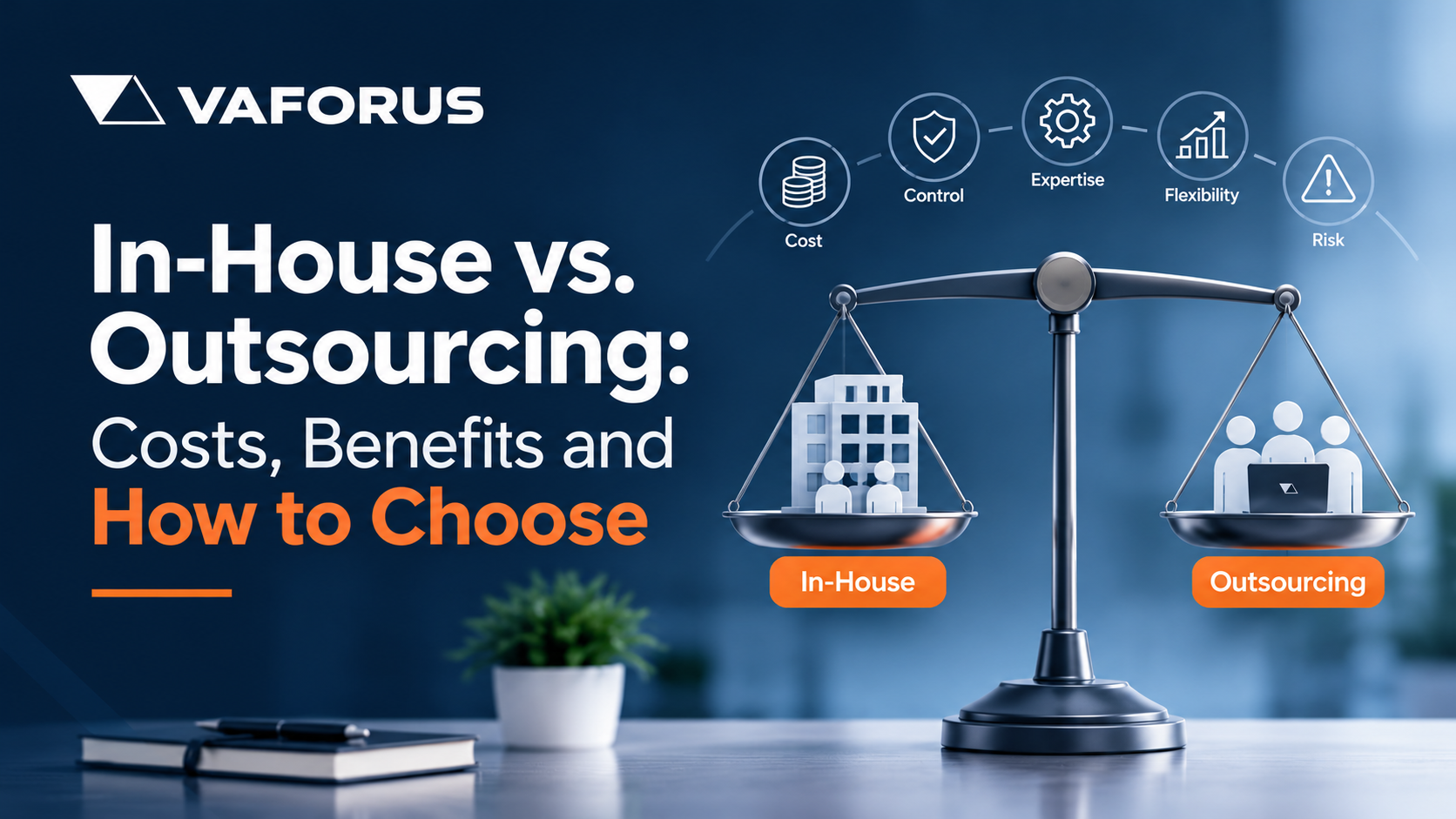
Every growing business hits the same wall: the work keeps piling up, and hiring a full-time employee for every function is expensive. The in-house vs. outsourcing decision comes down to what you can afford, what you need to control, and how quickly your needs change.
This guide compares in-house vs outsourcing on cost, control, expertise, flexibility, and risk, using current US cost data, so you can decide which model fits each part of your business.
The short answer: keep work in-house when it is core to your business, sensitive, and long-term. Outsource when the work is specialized, variable, or not worth a permanent hire. Many US businesses do both.
In-House vs. Outsourcing: What Is the Difference?
The main difference between in-house and outsourcing is who performs and manages the work. With an in-house team, you hire employees directly, while outsourcing means hiring an external company, agency, or freelancer to handle specific tasks.
Here is how the two approaches compare across key business factors:
1. Cost Structure
- In-house: You pay fixed costs, including salaries, employee benefits, payroll taxes, equipment, and other overhead.
- Outsourcing: You pay for the services or work you need, making costs more flexible.
2. Control and Management
- In-house: You have direct control over employees, daily priorities, and work processes.
- Outsourcing: You manage the work through agreed scopes, deliverables, communication, and reviews.
3. Access to Specialized Expertise
- In-house: You need to recruit and train employees to develop the skills your business requires.
- Outsourcing: You can access specialized skills without going through a lengthy hiring process.
4. Scalability and Flexibility
- In-house: Expanding or reducing your team requires hiring or letting employees go.
- Outsourcing: You can increase or reduce the scope of services as your workload and business needs change.
5. Institutional Knowledge
- In-house: Employees develop an understanding of your business, and that knowledge stays within the company while they remain.
- Outsourcing: Some operational knowledge and expertise remain with the external provider, creating potential dependency.
6. Data Security
- In-house: You manage employee access, internal policies, and data security directly.
- Outsourcing: You share access with an external provider, so security depends partly on its practices and the safeguards you put in place.
7. Company Culture
- In-house: Employees participate directly in your workplace culture, values, and daily operations.
- Outsourcing: External teams have less involvement in your internal company culture and activities.
Ultimately, neither model is automatically better. The right choice depends on your budget, workload, business priorities, and the level of control you need.
The Real Cost of In-House vs. Outsourcing
Salary is only part of what an employee costs. The US Bureau of Labor Statistics (BLS) measures what employers actually pay. In June 2026, total employer compensation for private industry workers averaged $46.89 per hour worked: $32.82 in wages and salaries and $14.07 in benefits, which is 30.0 percent. For full-time private industry workers, the total was $54.00 per hour, with benefits at $17.03, or 31.5 percent (BLS, June 2026).
That works out to about $1.46 of employer cost for every $1.00 of wages for a full-time employee, before recruiting, training, equipment, and management time.
What in-house costs include
- Salaries and wages
- Employee benefits, including health insurance, paid leave, and retirement contributions
- Payroll taxes and other legally required benefits, which averaged $3.76 per hour for full-time workers (7.0 percent)
- Recruiting time and cost
- Training costs and the ramp-up before a new hire is fully productive
- Equipment, software, and office overhead
- Management time and the cost of replacing people who leave
What outsourcing costs include
Outsourcing turns fixed labor costs into a fee. But the fee is not the whole cost of outsourcing. Add the time you spend writing briefs, giving access, reviewing work, and fixing misunderstandings. Switching providers later can cost money too.
The hidden costs on both sides
The outsourcing vs in-house cost question is rarely salary versus fee. Compare the total cost of each option over 12 to 24 months. A low fee is not a saving if you spend hours managing the work.
Cost savings from outsourcing are real when the work is variable or specialized, because you pay for output and skip the overhead. They shrink when you need a specialist full time. In that case, an in-house employee can cost less than an outside team's monthly fees.
Pros and Cons of Hiring In-House
Building an in-house team gives you the most control, and it asks the most of your budget and your management time.
Pros of in-house employees
- Direct control. You set priorities daily, change direction quickly, and see the work as it happens.
- Company culture. In-house employees absorb your values, customers, and ways of working.
- Institutional knowledge. What employees learn about your business stays with the company, as long as they stay.
- Confidentiality. Sensitive data and strategy stay inside your walls, which makes confidentiality easier to manage.
Cons of in-house employees
- Higher operating costs. Salaries, benefits, payroll taxes, and overhead continue in slow months.
- Slow recruiting. Finding, interviewing, and onboarding a new hire takes time before any work gets done.
- Employee turnover. When someone leaves, you pay to replace them and lose what they knew.
- Limited flexibility. Scaling an in-house team up or down means hiring or layoffs.
- Skill gaps. One full-time employee rarely covers design, ads, development, and email equally well.
Pros and Cons of Outsourcing
Outsourcing trades some control for expertise and flexibility. Whether that trade is worth it depends on the work.
Pros of outsourcing
- Specialized expertise. A provider that serves many clients has solved problems your team has not seen yet.
- Scalability. You can scale up or down as workload changes, without hiring or layoffs.
- Flexibility. You can start with one project or one function and add more later.
- Focus on your core business. Handing off non-core work frees your team for what customers pay you for.
- Lower overhead. You skip recruiting, equipment, and workspace costs, and you pay for the work you need.
- A global talent pool. You can reach skills that are scarce or expensive in your local market.
Cons of outsourcing
- Less direct control. You manage through briefs, reviews, and contracts, not hallway conversations.
- Communication gaps. Differences in time zones, tools, and expectations can slow things down without clear routines.
- Data security and confidentiality. Outside providers need access, so you need to limit and monitor it.
- Vendor dependency. If one provider holds your accounts, files, or know-how, switching gets harder.
- Uneven quality. A weak scope or a weak provider can mean rework.
How to Choose Between In-House and Outsourcing
The in-house vs outsourcing choice is not all-or-nothing. Decide function by function, and start with one question: is this work core or non-core?
Core work is what makes customers choose you, such as your product, your key relationships, and your strategy. Keep it in-house. Non-core work is necessary but does not set you apart, such as website upkeep, email campaigns, bookkeeping, or lead research. These are the best candidates to outsource.
Capterra's 2022 survey of 1,078 US small and midsize business professionals found two common reasons companies outsource. Of those surveyed, 44% had the expertise but not the bandwidth, and 31% had the bandwidth but not the expertise (Capterra). Capacity and skills are a useful place to start.
A six-question decision framework
Answer these for each function:
- Is the work core to how you win customers?
- Is the need steady all year, or does it rise and fall?
- Does your team already have the skill, or would you need to hire or train for it?
- How sensitive is the data involved?
- Do you have the management time to supervise an outside team or a new hire?
- What is the total cost of each option over 12 to 24 months?
If most answers point to core, steady, skilled, sensitive, and managed, lean in-house. If most point to non-core, variable, missing skills, and manageable data, lean toward outsourcing. Mixed answers usually mean a hybrid.
When to outsource
- The work is non-core, specialized, or seasonal.
- You lack the skill, and hiring for it would take months.
- You need the function but not a full-time employee.
- Your team has the skill but not the bandwidth.
When to hire in-house
- The work is core to your business and long-term.
- It involves sensitive data or strategy.
- It needs daily collaboration and fast changes of direction.
- It fills a role you would use about 40 hours a week.
The Hybrid Approach: Keep Strategy In-House, Outsource Execution
For many businesses, the best answer is a hybrid approach. You keep strategy, priorities, and sensitive decisions in-house, and you outsource execution and specialist work.
Here is what a hybrid model can look like:
- An in-house marketing lead sets strategy, while an outside team handles SEO content, email campaigns, and ad management.
- An in-house operations manager owns processes, while an outsourced team builds and maintains the website.
- An in-house sales leader owns the pipeline, while an outsourced team researches prospects and runs outbound outreach.
The split should change as you grow. A function you outsource today may become a full-time role later, once the workload justifies it. Review the arrangement every few months and move work in or out as your needs change.
Outsourcing Risks for US Businesses and How to Manage Them
Most outsourcing problems come from unclear expectations, not from outsourcing itself. These are the risks to plan for, and how to handle each one.
Location: onshore, nearshore, or offshore
- Onshore outsourcing uses a provider in the United States.
- Nearshore outsourcing uses a provider in a nearby country with similar time zones.
- Offshore outsourcing uses a provider in a distant country, often at a lower cost.
Offshore teams can cost less, but you need to plan for time zone overlap. Ask how many hours of overlap the team offers with your US business hours, and agree on response times in writing.
Data security and compliance
- Give the provider only the access the work requires, and remove it when the work ends.
- Use a signed confidentiality agreement and ask how credentials and files are stored.
- If the work touches regulated data, such as health or financial records, check the compliance requirements with your attorney before you outsource.
Vendor dependency and quality
- Keep ownership of your accounts, domains, files, and documentation.
- Define deliverables, review points, and what "good" looks like before work starts.
- Name one person on your side who owns the relationship.
In-House vs. Outsourcing for Small Businesses and Startups
Small businesses and startups feel this decision most. Budgets are tight, and one full-time employee is a large share of payroll. Capterra's survey notes that many small and midsize businesses lack the budget or workload for full-time development, accounting, or marketing teams, which makes outsourcing the practical choice for those functions.
A useful rule: outsource a function until it fills a full-time role. Until then, a full-time employee sits partly idle while you still pay benefits and payroll taxes.
Small business outsourcing usually starts with one function, such as web development, SEO, or email marketing. Startups can start with a single project, learn what works, and add more later. Whether to hire in-house or outsource is also a question of timing, so revisit the decision as the business grows.
How to Choose an Outsourcing Partner (and Where Vaforus Fits)
If outsourcing fits, the provider matters more than the model. Ask any outsourcing company or partner these questions:
- Who will do the work, and is it a dedicated team or a rotating pool?
- Who supervises the work, and who do I contact when something goes wrong?
- How are fees, scope, and timelines agreed, and what is excluded?
- How do you protect my data, and how is access removed when we finish?
- Can I take my accounts, files, and documentation with me if I leave?
- Can we start with one function before committing to more?
Vaforus offers business outsourcing services for companies that want to outsource business tasks without hiring a full-time team. It is a managed outsourcing company: you work with a dedicated remote team across web development, SEO and content, email marketing, lead generation, social media, and digital advertising, and the founder supervises the work. Fees and timelines are agreed before any work starts.
In-House vs. Outsourcing FAQs
1. Is outsourcing cheaper than hiring in-house?
Often, for variable or specialized work, because you skip benefits, payroll taxes, recruiting, and overhead. Not always. If you need a specialist full time, the outsourcing vs in-house math can favor an employee. Compare total cost over 12 to 24 months.
2. Can you combine in-house and outsourced teams?
Yes. A hybrid approach keeps strategy and sensitive work in-house and outsources execution. Name one person on your side to manage the outside team.
3. What should you outsource first?
Start with non-core, repeatable work where results are easy to check, such as website maintenance, email campaigns, SEO content, or lead research.
4. When should you keep work in-house?
Keep work in-house when it is core to your business, involves sensitive data, needs daily collaboration, or fills a full-time role.
5. What is the difference between outsourcing and offshoring?
Outsourcing means hiring an external provider to perform specific business functions or tasks. Offshoring means moving business operations to another country. A company can offshore its operations through its own foreign office or outsource them to an independent provider overseas.
6. Is outsourcing a good option for startups with limited budgets?
Yes. Outsourcing can help startups access specialized skills without committing to full-time salaries, employee benefits, and recruitment costs. It also allows founders to delegate non-core tasks while focusing on product development, customer acquisition, and business growth.
7. What business functions can be outsourced instead of hiring employees?
Businesses commonly outsource functions such as:
- Digital marketing and advertising
- SEO and content creation
- Lead generation and outbound sales
- Web development and maintenance
- Social media management
- Email marketing
- Bookkeeping and administrative support
The right functions to outsource depend on your internal capabilities, workload, and business priorities.
Conclusion: In-House vs. Outsourcing — Choose What Works for Your Business
There is no one-size-fits-all answer to the in-house vs. outsourcing decision. The right approach depends on your business priorities, available resources, workload, and the level of control each function requires.
For most growing businesses, the smartest approach is to keep core decisions and strategic responsibilities in-house while outsourcing specialized or non-core execution. This gives you access to the skills and capacity you need without taking on the long-term costs of expanding your payroll.
Start by identifying the tasks consuming your team's time, evaluate whether they justify a full-time hire, and compare the actual costs of both options. As your business grows, review that balance and adjust accordingly.
If you need reliable execution without building another in-house department, Vaforus can help. Our managed outsourcing teams support businesses with web development, SEO and content, email marketing, lead generation, social media management, and digital advertising. We work as an extension of your team, with founder-led supervision to keep projects moving and work accountable.
Outsource and grow without expanding your in-house team.