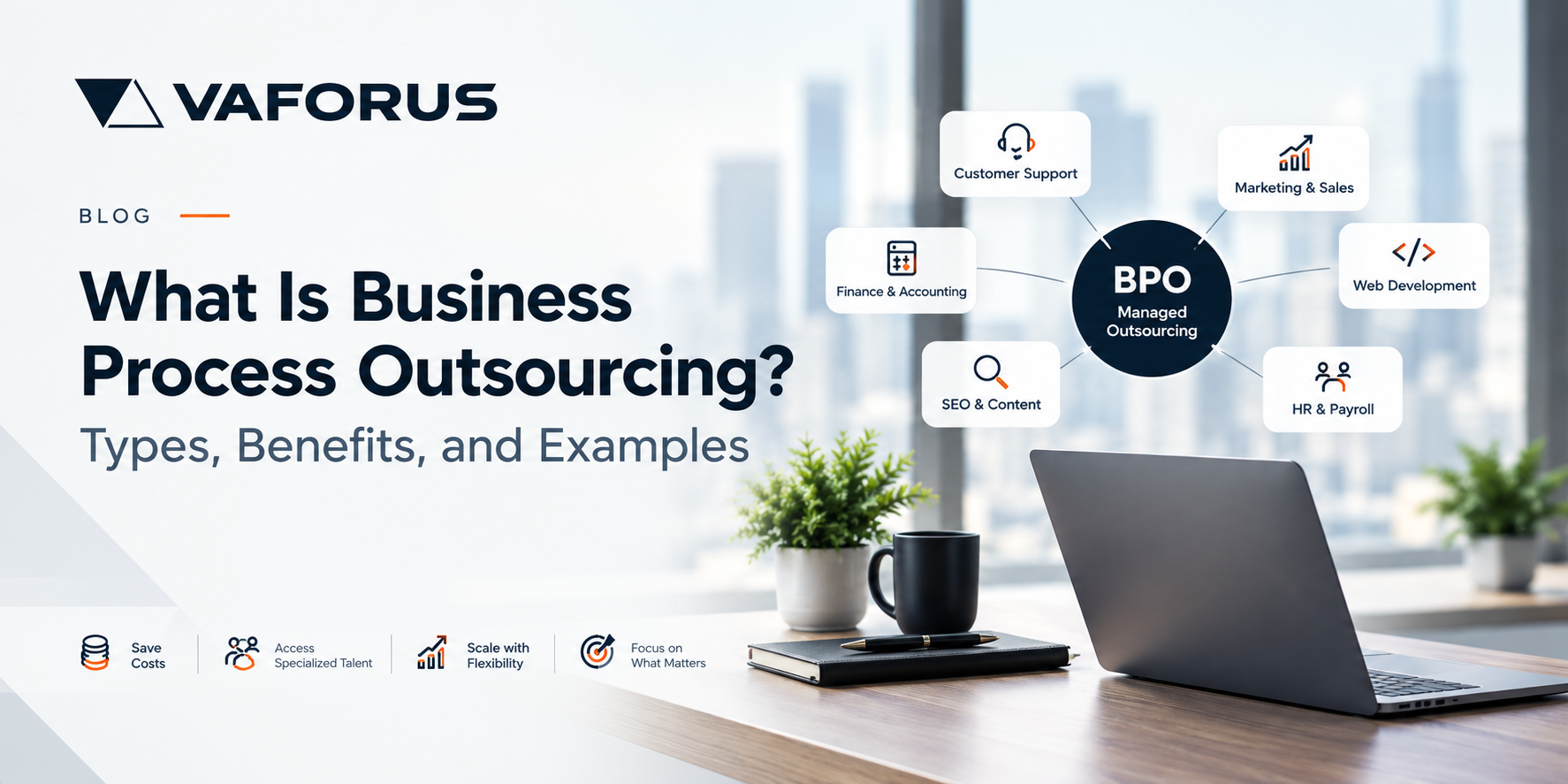
Business process outsourcing (BPO) is the practice of hiring an external service provider to manage specific business tasks or processes instead of handling them entirely in-house. Companies use BPO to reduce operating costs, access specialized expertise, improve efficiency, and free up internal teams to focus on core business activities.
From customer support and payroll to lead generation, SEO, and web development, business process outsourcing helps companies of different sizes get essential work done without building a large internal team.
1. What Is BPO and How Does It Work?
BPO involves transferring responsibility for a particular business function to a third-party provider. Depending on the agreement, the provider may manage an entire process or handle selected tasks under the client's direction. Services can be delivered remotely or on-site, with responsibilities, performance expectations, and communication methods defined in advance.
For example, a growing company might outsource its lead generation and content marketing rather than hire separate full-time employees for each function. A managed BPO provider can coordinate the work, supervise execution, and report on progress while the client focuses on sales, product development, and business growth.
2. What Are the Types of BPO?
Business process outsourcing can be classified by the function being outsourced and the provider's location.
- Front-office BPO: Customer-facing activities such as customer service, technical support, sales, and call center operations.
- Back-office BPO: Internal processes such as accounting, payroll, data entry, and human resources administration.
- Onshore outsourcing: Working with a provider in the same country.
- Nearshore outsourcing: Outsourcing to a nearby country, often with similar time zones.
- Offshore outsourcing: Hiring a provider in a more distant country, often to access specialized talent or lower operating costs.
Other specialized forms include knowledge process outsourcing (KPO), which covers knowledge-intensive work; legal process outsourcing (LPO), which supports legal tasks; and recruitment process outsourcing (RPO), where a provider manages some or all of the recruitment process.
3. What Are Some Examples of BPO?
Common business process outsourcing examples include customer support teams handling inquiries, external accountants managing bookkeeping, and HR providers processing payroll or assisting with recruitment. Businesses also outsource data entry, IT helpdesk services, call center operations, and administrative tasks to reduce the workload on internal employees.
BPO also covers digital and growth-related activities. For example, an e-commerce business may outsource lead generation, appointment setting, email marketing, search engine optimization (SEO), blog writing, or website development. These services help businesses maintain consistent execution without hiring an employee for every function.
4. What Are the Benefits of BPO?
The main benefits of business process outsourcing include lower operating costs, access to specialized expertise, greater flexibility, and more time for core business activities. Businesses can avoid some of the expenses associated with recruiting, training, salaries, benefits, equipment, and office space. Outsourcing can also make it easier to scale support up or down as business needs change.
BPO providers may also bring established workflows, industry knowledge, and technology that would otherwise take time and money to develop internally. For small businesses and startups, outsourcing can make specialist support more accessible while helping existing teams concentrate on strategy, customer relationships, and revenue growth.
5. What Are the Risks of BPO and How Can They Be Managed?
BPO comes with risks, including data security and privacy concerns, communication or cultural barriers, inconsistent service quality, and dependence on an external provider. Businesses may also face compliance challenges if the outsourced work involves sensitive customer information or regulated activities. Poorly defined responsibilities can lead to delays, misunderstandings, and disappointing results.
These risks can be managed by checking a provider's experience and security practices, establishing clear service-level agreements (SLAs) and key performance indicators (KPIs), and setting regular communication routines. Contracts should define responsibilities, confidentiality, data access, performance expectations, and exit terms. Certifications such as ISO 27001 may provide additional assurance when relevant, but businesses should verify the provider's actual certification status and scope.
6. BPO vs. Outsourcing vs. BPM: What's the Difference?
Outsourcing means hiring an external provider to handle work for your business. Business process outsourcing (BPO) is a type of outsourcing focused on specific business functions, such as customer support, accounting, or lead generation.
Business process management (BPM), on the other hand, involves improving how business processes work, whether they are handled internally or externally.
Here are some simple examples:
- Outsourcing: Hiring a developer to build your website.
- BPO: Hiring an external team to manage your ongoing lead generation.
- BPM: Improving your sales process to help your team work more efficiently.
BPO can help businesses reduce workload, access specialized skills, and scale more flexibly. However, keeping work in-house may be better when it involves highly sensitive information or requires close, day-to-day control.
7. How Do You Choose the Right BPO Provider?
Start by identifying which tasks you want to outsource, what outcomes you expect, and how success will be measured. Compare providers based on relevant experience, service quality, communication, security practices, staffing arrangements, and their ability to scale with your business. Ask who will supervise the work, how progress will be reported, and what happens when performance falls short.
Understand the full cost before signing a contract. BPO pricing models may include hourly rates, per-agent fees, per-transaction charges, or fixed monthly fees. Compare the total cost of outsourcing with the cost of delivering the same work in-house, including recruitment, training, management time, technology, and employee benefits. The cheapest quote is not always the best value.
8. BPO Trends in 2026
Business process outsourcing is increasingly shaped by artificial intelligence (AI), robotic process automation (RPA), cloud-based collaboration, and data-driven performance management. These technologies can automate repetitive tasks, support faster reporting, and improve consistency. Hyperautomation, which combines multiple automation technologies to streamline workflows, is also influencing how providers deliver services.
Another important trend is the shift toward flexible, outcome-focused partnerships rather than purely transactional arrangements. Businesses increasingly want providers who understand their goals, communicate transparently, and take responsibility for execution. For e-commerce businesses and growing companies, this can mean combining human expertise with automation across customer support, marketing, sales operations, and digital services. The right approach depends on the process, budget, and desired results.
9. Is BPO Suitable for Small Businesses?
Yes. Business process outsourcing can be particularly useful for small businesses and startups that need specialist support but cannot justify hiring a full-time team. Instead of managing separate employees for marketing, sales, administration, or technical work, a business can outsource selected functions based on its immediate priorities and budget.
For example, a startup could outsource website maintenance, SEO content, and outbound lead generation while keeping product development and customer relationships in-house. A managed outsourcing partner such as Vaforus can coordinate and supervise outsourced execution, helping businesses extend their capabilities without building every function internally.
10. Frequently Asked Questions About BPO
What is BPO in simple words?
BPO means hiring another company to handle specific business tasks or processes instead of doing everything with your own employees.
What is a common example of BPO?
A company hiring an external team to manage customer support, bookkeeping, payroll, lead generation, or digital marketing is using BPO.
What are the main types of BPO?
The main functional types are front-office and back-office BPO. By location, outsourcing can be onshore, nearshore, or offshore. Specialized categories include KPO, LPO, and RPO.
Is BPO cheaper than hiring in-house?
It can be. BPO may reduce recruitment, training, staffing, and infrastructure costs, but the actual savings depend on pricing, service quality, and the complexity of the work.
What is the difference between BPO and a call center?
A call center is one type of outsourced service focused on telephone-based customer interactions. BPO is broader and can include customer support, finance, HR, sales, marketing, IT, and other business functions.
What should a BPO contract include?
A BPO contract should define the scope of work, pricing, service levels, performance metrics, data security responsibilities, confidentiality, contract duration, and termination or transition arrangements.
Final thoughts
Business process outsourcing allows companies to delegate essential business functions, access specialized expertise, and scale operations without building every capability in-house. The key is choosing the right provider, defining clear expectations, and maintaining visibility into performance.
At Vaforus, we help businesses outsource marketing, sales, web development, and digital operations through a managed approach. Our team works as an extension of yours, with supervised execution designed to help you get more done without expanding your in-house team.
Ready to explore managed outsourcing for your business? Schedule a Discovery Call.