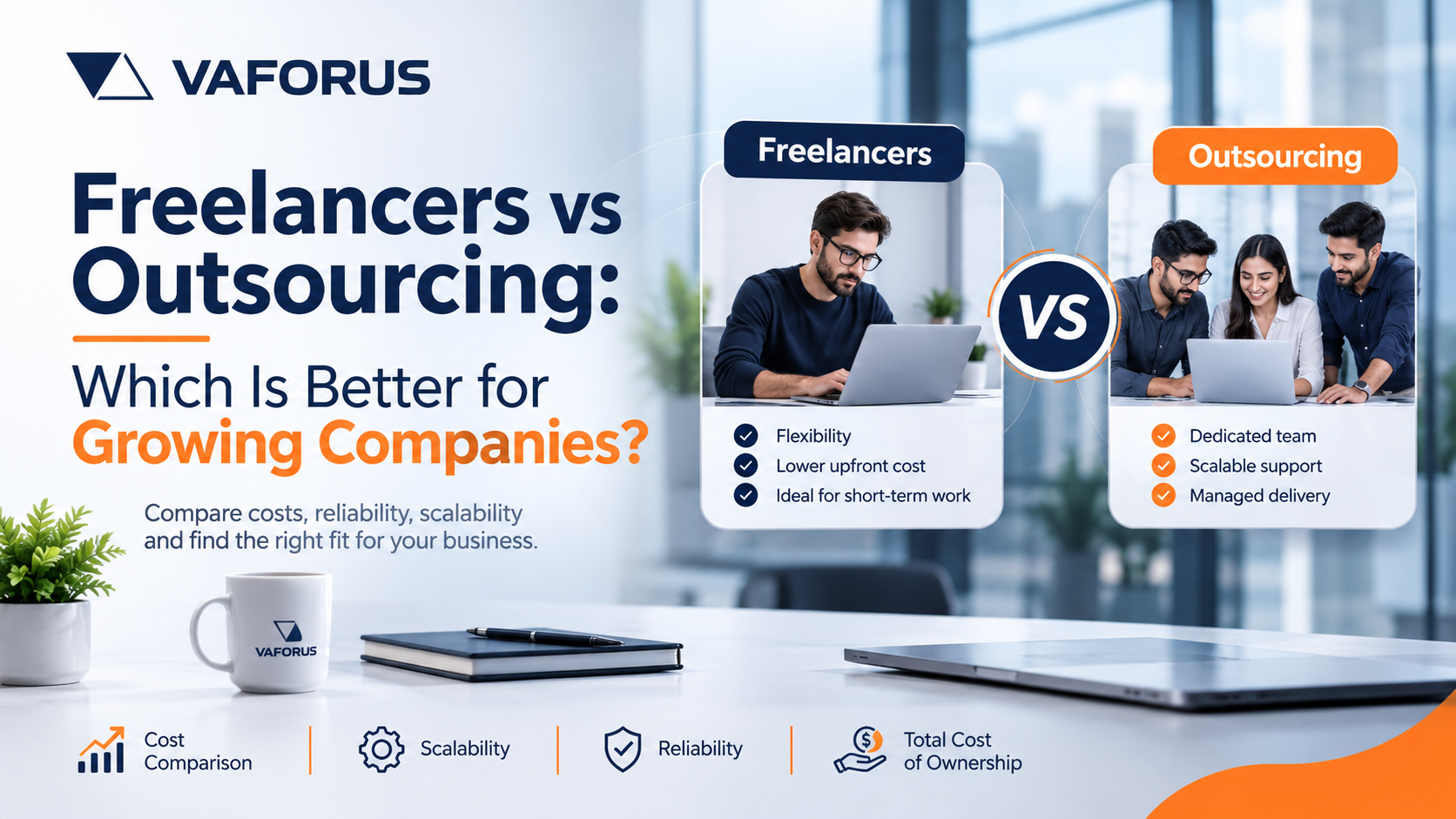
Growing a business often means taking on more work than your existing team can comfortably manage. Whether it's marketing, web development, lead generation, or daily business operations, companies eventually need additional resources to maintain productivity and continue growing.
Two common solutions are hiring freelancers or working with an outsourcing company. While both options provide access to external expertise, they differ significantly in cost structure, management, reliability, and long-term scalability.
For growing companies, freelancers are often suitable for individual tasks and short-term projects, while outsourcing provides a more structured solution for ongoing business operations. The right choice depends on how much work needs to be handled, how much supervision is required, and whether the business needs individual expertise or a managed team.
Understanding outsourcing vs freelancers can help business owners make a more informed decision about where to invest their resources.
1. What Is the Difference Between Freelancers and Outsourcing?
Before comparing the two models, it's important to understand how each works.
What Are Freelancers?
Freelancers are independent professionals who offer specialized services to businesses on a project, hourly, or contractual basis. Companies typically hire freelancers when they need specific expertise without committing to a full-time employee.
For example, a growing company might hire:
- A freelance graphic designer for marketing materials.
- A freelance web developer for a website redesign.
- A freelance SEO specialist for search optimization.
- A freelance copywriter for blog content.
- A freelance lead generation specialist for prospect research.
Platforms such as Upwork, Fiverr, and Freelancer make it easier to find professionals with different skills and experience levels.
The main advantage of freelancers is flexibility. Businesses can hire freelancers when work becomes available and reduce their commitments when a project is completed.
However, freelancers generally operate independently. This means businesses are often responsible for assigning tasks, communicating requirements, reviewing deliverables, and coordinating different contractors.
For companies with limited internal management capacity, these responsibilities can become challenging over time.
What Is Outsourcing?
Outsourcing involves assigning specific business functions, responsibilities, or ongoing tasks to an external outsourcing company rather than managing every activity internally.
Unlike hiring an individual contractor, an outsourcing arrangement can provide access to multiple professionals working together under an established management structure.
For example, a business might outsource:
- Digital marketing and social media management.
- Lead generation and outbound sales operations.
- Website development and maintenance.
- SEO and content production.
- Email marketing and customer retention.
- Administrative and operational processes.
An outsourcing company typically handles team coordination, task supervision, delivery management, and quality control, depending on the agreed scope of work.
This makes outsourcing particularly useful for growing businesses that need consistent execution without recruiting, training, and managing several full-time employees.
Business process outsourcing (BPO) is a broader form of this approach, where companies delegate specific business processes to an external provider.
The key distinction is that outsourcing can provide an operating structure, not simply access to another individual with specialized skills.
2. Outsourcing vs Freelancers: Key Differences Compared
Both models can help businesses reduce workloads and access specialized expertise. However, their operating structures make them suitable for different situations.
Freelancers vs Outsourcing: A Practical Comparison
Freelancers:
- Hiring: Individual professionals.
- Cost: Hourly, project-based, or monthly retainer.
- Management: Usually handled internally by the client.
- Reliability: Depends on the freelancer's availability and consistency.
- Scalability: Requires hiring additional freelancers as workload increases.
- Expertise: Access to individual specialized skills.
- Communication: Direct communication with each contractor.
- Short-term projects: Ideal for one-time assignments and specific deliverables.
- Ongoing support: Depends on the freelancer's availability and agreement.
- Accountability: Individual contractor is responsible for agreed deliverables.
- Flexibility: Easy to adjust individual assignments.
- Continuity: Work may be affected if the freelancer becomes unavailable.
Outsourcing Company:
- Hiring: Access to a managed external team.
- Cost: Usually a monthly retainer or an agreed service scope.
- Management: Provider handles internal supervision and coordination.
- Reliability: Supported by team structure and established processes.
- Scalability: Resources can be expanded through the outsourcing provider.
- Expertise: Access to multiple complementary skill sets.
- Communication: Typically through a designated point of contact.
- Short-term projects: Suitable depending on the provider and scope of work.
- Ongoing support: Can be structured around continuous delivery.
- Accountability: Provider is accountable for agreed services and deliverables.
- Flexibility: Scope and resources can be adjusted as business needs change.
- Continuity: Can be maintained through team coverage and internal coordination.
The most important difference is the level of responsibility the business retains.
When hiring freelancers, the company generally coordinates the individuals and their work. With a managed outsourcing arrangement, the provider takes responsibility for supervising the agreed services and coordinating execution.
For growing companies, this distinction can become more important than the initial cost.
3. Cost Comparison: Are Freelancers Cheaper Than Outsourcing?
Cost is often the first consideration when comparing freelancers or outsourcing agencies.
At first glance, hiring an individual freelancer can appear more affordable. Businesses only pay for the specific work they need, without committing to an entire team.
However, comparing hourly rates alone does not provide an accurate picture of the total investment.
The Cost of Hiring Freelancers
Freelancers usually charge according to their experience, specialization, and project requirements.
A business hiring several freelancers may need to pay separately for:
- Web development.
- Graphic design.
- Content writing.
- SEO management.
- Social media management.
- Lead generation.
In addition to these payments, the company may need to allocate internal resources for communication, supervision, revisions, and quality assurance.
These responsibilities create additional expenses that are not always reflected in a freelancer's quoted rate.
The Cost of Working With an Outsourcing Company
An outsourcing company may offer several services through one managed arrangement.
Instead of coordinating multiple individual contractors, businesses work with a provider that organizes the resources required to deliver the agreed work.
Depending on the arrangement, the monthly cost may include:
- Access to specialized professionals.
- Internal supervision and management.
- Task coordination.
- Quality checks.
- Ongoing operational support.
This can make outsourcing more cost-effective when a business requires multiple services or consistent monthly execution.
Understanding Total Cost of Ownership
The total cost of ownership goes beyond the amount paid to a freelancer or outsourcing agency.
Businesses should also consider hidden costs such as:
- Time spent finding and evaluating professionals.
- Training and onboarding.
- Managing multiple contractors.
- Revisions caused by unclear communication.
- Replacing unavailable freelancers.
- Delays caused by coordination problems.
These hidden costs can make an apparently inexpensive arrangement more expensive over time.
The better cost comparison is not simply freelancer rates versus outsourcing fees. It is the total cost of getting the required work completed reliably.
For short-term projects, freelancers may offer better value. For multiple ongoing responsibilities, outsourcing can provide a more predictable cost structure.
4. Reliability and Management: Who Takes Responsibility?
Reliability is another important factor when deciding between freelancers and an outsourcing company.
A business can find an exceptionally talented freelancer, but individual performance and availability are not the same as having a dependable delivery structure.
Managing Freelancers
When businesses hire freelancers, they generally remain responsible for:
- Assigning and explaining tasks.
- Setting deadlines and expectations.
- Following up on progress.
- Reviewing completed work.
- Managing revisions.
- Coordinating different professionals.
This approach works well when a company has someone internally who can supervise the work.
However, when several freelancers are involved, management becomes increasingly complicated. Each professional may have different working hours, communication preferences, priorities, and delivery processes.
If one freelancer becomes unavailable, the business may also need to find a replacement and transfer the necessary knowledge.
Working With an Outsourcing Company
A managed outsourcing company provides a more structured approach to execution.
Rather than coordinating individual contractors, the business communicates with a provider responsible for managing the agreed scope of work.
A reliable outsourcing agency should have:
- Defined responsibilities and deliverables.
- Internal supervision.
- Consistent communication.
- Quality assurance processes.
- Backup resources where appropriate.
- Clear accountability for agreed work.
This does not mean outsourcing eliminates every management responsibility. Businesses still need to provide direction, share information, review strategic decisions, and communicate priorities.
However, the provider takes responsibility for coordinating day-to-day execution within the agreed arrangement.
For growing companies, this can free up valuable time for business development, customer relationships, and strategic planning.
5. Scalability: Which Model Supports Business Growth?
Scalability is where the difference between freelancers and outsourcing becomes particularly noticeable.
A business might initially need one designer, one developer, or one marketing specialist. As operations expand, however, its requirements can change considerably.
Scaling With Freelancers
Freelancers offer flexibility when a business needs additional expertise.
A company can hire different professionals as new projects arise, making this model useful for businesses with changing or unpredictable workloads.
However, scaling through freelancers often means repeating the hiring and onboarding process.
Adding more contractors also increases the management workload. Someone must coordinate responsibilities, maintain consistent standards, and ensure everyone is working toward the same objectives.
The model can become difficult to manage when several freelancers are responsible for interconnected activities.
Scaling With Outsourcing
An outsourcing company can offer a more scalable arrangement by providing access to additional resources through an established delivery structure.
For example, a growing company might begin by outsourcing SEO and content production. Later, it could expand the engagement to include social media management, website development, or lead generation.
Instead of independently recruiting professionals for every new responsibility, the business can discuss expanding its existing arrangement.
This is particularly useful when a company needs:
- Multiple specialized skills.
- Consistent monthly execution.
- Additional operational capacity.
- Long-term support.
- A dedicated team that understands its business.
Scalability ultimately depends on the outsourcing partner's capacity, processes, and ability to accommodate changing requirements.
Nevertheless, a managed arrangement can make expansion more straightforward than continuously recruiting individual contractors.
6. Specialized Skills and Expertise: What Does Your Business Need?
Both freelancers and outsourcing agencies can provide access to specialized skills. The difference lies in how those skills are organized and delivered.
When Freelancers Are the Better Choice
Freelancers can be an excellent option when a business needs one specific skill for a clearly defined project.
For example:
- A company needs a Shopify developer to fix a technical issue.
- A startup needs a copywriter for a product launch.
- An organization requires a graphic designer for a one-time campaign.
- A business needs a specialist to conduct a technical SEO audit.
In these situations, hiring an individual with the right expertise may be sufficient.
There is no reason to commit to a broader outsourcing arrangement if the requirement is limited and temporary.
When Outsourcing Is the Better Choice
Outsourcing becomes more attractive when a business needs several complementary skills working together.
Consider a company trying to improve its online presence.
It might require SEO research, blog production, social media management, website updates, and ongoing performance monitoring.
Hiring separate freelancers for every responsibility can create unnecessary coordination.
An outsourcing company can organize these activities through a managed team, allowing the business to access different areas of expertise through one working relationship.
This is especially valuable for growing businesses that need specialized skills but cannot justify building a full in-house department.
7. Short-Term Projects vs Long-Term Business Operations
The duration and nature of the work should influence your decision.
Not every business requirement needs a long-term outsourcing arrangement.
Freelancers for Short-Term Projects
Freelancers are particularly useful for short-term projects with clear deliverables and defined deadlines.
Examples include:
- Designing a company logo.
- Developing a landing page.
- Writing a limited number of articles.
- Fixing website functionality.
- Creating campaign graphics.
Once the project is complete, the business can conclude the engagement without maintaining an ongoing relationship.
This provides flexibility and avoids unnecessary commitments.
Outsourcing for Ongoing Support
Outsourcing is generally more suitable when the work requires continuous attention and consistent execution.
For example, marketing activities rarely end after one project. SEO requires ongoing optimization, social media requires regular publishing, and outbound sales requires continuous prospecting and follow-up.
An outsourcing company can provide ongoing support through an agreed monthly arrangement.
The business also benefits from established processes, internal supervision, and a team that becomes familiar with its operations.
For companies looking to maintain consistent output without expanding their full-time workforce, this can be a practical solution.
8. Offshore Outsourcing: An Additional Option for Growing Companies
Offshore outsourcing allows businesses to work with service providers located in other countries.
It has become an attractive option for companies looking to access specialized talent and reduce operational expenses without compromising their ability to deliver work.
For example, a company based in the United States, United Kingdom, or Australia may work with an outsourcing company in Pakistan to manage selected marketing, development, or operational responsibilities.
The potential advantages include:
- Access to international talent.
- Lower operating costs in some markets.
- Flexible team arrangements.
- Access to multiple skill sets.
- Reduced recruitment and infrastructure expenses.
However, offshore outsourcing also requires careful consideration.
Businesses should evaluate communication standards, time-zone compatibility, data security, confidentiality policies, work quality, and management processes before choosing a provider.
A lower price should never be the only selection criterion.
The right outsourcing partner should understand the company's requirements, establish clear responsibilities, and provide reliable supervision.
9. Data Security and Confidentiality: Which Option Is Safer?
Businesses should not overlook data security when deciding between freelancers and outsourcing.
Both arrangements involve sharing information with external professionals, and neither is automatically secure.
When hiring freelancers, companies may need to manage separate confidentiality agreements, access permissions, and security requirements for every contractor.
This becomes more complicated when several individuals have access to customer information, marketing accounts, internal documents, or business systems.
An outsourcing company can provide a more centralized approach to security and confidentiality, provided it has appropriate policies and controls.
Before signing an agreement, businesses should check:
- Whether a non-disclosure agreement (NDA) is available.
- How sensitive information is stored and accessed.
- Whether team members receive security training.
- How access to business accounts is controlled.
- What happens when an engagement ends.
- Whether the provider follows relevant data protection requirements.
A managed team can make it easier to establish consistent security procedures, but businesses should verify the actual practices rather than assume that every outsourcing agency follows the same standards.
10. Hybrid Model: Combining Freelancers and Outsourcing
Choosing between freelancers and outsourcing does not always mean selecting only one.
A hybrid model combines outsourcing for ongoing business functions with freelancers for specialized or occasional projects.
This approach can offer growing businesses a useful balance of flexibility and operational consistency.
For example, a company could:
- Outsource its SEO and social media operations.
- Use freelancers for occasional graphic illustrations.
- Work with an outsourcing company for lead generation.
- Hire a freelance developer for a specialized technical integration.
In this arrangement, the outsourcing provider manages recurring responsibilities, while independent professionals handle work that falls outside the regular scope.
A hybrid model can also help companies avoid paying for resources they only need occasionally.
However, businesses should establish clear responsibilities between their outsourcing partner and individual contractors to prevent duplicated work, communication gaps, and conflicting priorities.
11. When to Switch From Freelancers to an Outsourcing Agency
Many growing companies begin by hiring freelancers because it is convenient and relatively inexpensive.
There is nothing wrong with this approach. In fact, it can be an excellent starting point.
The challenge arises when the business grows beyond what individual contractors can comfortably support.
Here are some signs that it may be time to consider an outsourcing agency:
1. You are managing too many contractors.
If you regularly coordinate several freelancers, follow up on deadlines, and review different deliverables, the management workload may be becoming counterproductive.
2. Your business needs ongoing execution.
When marketing, sales, development, or administrative activities require continuous attention, individual project-based arrangements may no longer be sufficient.
3. Work is becoming inconsistent.
If delivery quality, communication, or availability varies between contractors, a more structured arrangement may provide better continuity.
4. You need multiple specialized skills.
Businesses often reach a stage where one professional cannot cover all their requirements. A managed team can bring complementary expertise together.
5. You want to focus on business growth.
If managing external professionals is taking time away from sales, strategy, and customer relationships, outsourcing can reduce the operational burden.
6. Your internal team has reached capacity.
When existing employees are overloaded, outsourcing can provide additional resources without immediately committing to full-time recruitment.
The decision should be based on operational needs rather than business size alone. Even a small company can benefit from outsourcing if it requires consistent execution across multiple functions.
12. How an Outsourcing Company Works With Your Business
A professional outsourcing company should provide more than access to external professionals.
The objective is to establish a working relationship where the provider becomes an extension of the client's existing team.
A typical managed outsourcing arrangement involves the following steps.
Step 1: Understanding Your Requirements
The outsourcing company first evaluates your business, operational challenges, priorities, and required services.
This helps establish the scope of work and identify the resources needed for delivery.
Step 2: Defining Responsibilities
Both parties agree on deliverables, communication processes, deadlines, reporting requirements, and responsibilities.
Clear expectations reduce misunderstandings and establish accountability.
Step 3: Assigning the Right Team
The outsourcing company assigns professionals with the relevant specialized skills and expertise.
Depending on the scope, this could involve one professional or a dedicated team covering multiple business functions.
Step 4: Supervision and Execution
The provider coordinates the team's work, monitors progress, and manages day-to-day execution.
The client remains involved in providing direction, approving important decisions, and communicating changing priorities.
Step 5: Ongoing Optimization
As the business grows, requirements may change.
The outsourcing company can review the arrangement with the client and adjust the scope, resources, or workflows where appropriate.
This structure helps companies access ongoing support without independently managing every contractor.
13. How Vaforus Helps Growing Companies With Managed Outsourcing
At Vaforus , we believe growing businesses should be able to access the operational support they need without constantly expanding their in-house workforce.
Our approach to outsourcing is built around managed execution, internal supervision, and long-term working relationships.
Rather than simply connecting businesses with independent freelancers, Vaforus operates as an extension of the client's team.
We provide support across several business functions, including:
- Web Development: Business websites, landing pages, website redesigns, and ongoing maintenance.
- SEO and Blog Content: Search optimization, content planning, keyword research, and blog production.
- Lead Generation and Outbound Sales: Prospect research, lead lists, outreach campaigns, and outbound operations.
- Social Media Management: Content planning, publishing, and account management.
- Email Marketing: Campaign management, retention marketing, and customer communication.
- Digital Advertising: Meta and Google Ads management.
Our managed outsourcing model is designed for startups, agencies, and growing companies that need reliable execution without the costs and responsibilities associated with building another full-time team.
With a Pakistan-based remote team, we work with businesses internationally, providing access to specialized expertise through one managed working relationship.
The objective is straightforward: help businesses get more done without expanding their internal workforce unnecessarily.
Looking for an outsourcing partner that can become an extension of your team?
14. Freelancers or Outsourcing Agencies: Which Is Better for Your Business?
There is no universal answer to outsourcing vs freelancers. The better option depends on the type of work, the level of management required, the available budget, and the company's growth objectives.
Freelancers are generally better suited for:
- One-time website design or development projects.
- Occasional tasks requiring specialized expertise.
- Short-term assignments with clearly defined deliverables.
Outsourcing is generally better suited for:
- Ongoing SEO and content production.
- Continuous lead generation and outbound sales operations.
- Managing multiple marketing functions.
- Dedicated operational support.
- Several interconnected business activities that require consistent coordination.
A Hybrid Model Works Well For:
- Businesses that need ongoing outsourcing support but occasionally require freelancers for specific projects or additional specialized skills.
The key is to choose a model that matches your workload, management capacity, and long-term business requirements.
Frequently Asked Questions
1. What is the difference between freelancers and outsourcing?
Freelancers are independent professionals hired to complete specific tasks or projects, while outsourcing involves delegating business functions to an external service provider. An outsourcing company may provide multiple professionals, internal supervision, and ongoing operational support, reducing the need for businesses to coordinate individual contractors.
2. Which is better for growing companies, freelancers or outsourcing?
Outsourcing is generally better for growing companies that need consistent execution across multiple business functions. Freelancers are more suitable for individual projects and occasional expertise, while a managed outsourcing arrangement provides ongoing support, team coordination, and greater operational scalability.
3. Is outsourcing cheaper than hiring freelancers?
Outsourcing can be more cost-effective when businesses require multiple professionals or ongoing services. Although individual freelancers may have lower hourly rates, companies must also consider management time, coordination, onboarding, and replacement costs. The best option depends on the total cost of ownership rather than initial pricing alone.
4. Are freelancers more reliable than an outsourcing company?
Reliability depends on the individual professional or outsourcing provider. However, an established outsourcing company can offer additional continuity through internal supervision, team coordination, and backup resources. Freelancers may be perfectly reliable for individual assignments, but ongoing operations often benefit from a structured delivery arrangement.
5. When should a growing business switch from freelancers to an outsourcing company?
A growing business should consider switching when managing multiple freelancers becomes time-consuming, delivery becomes inconsistent, or ongoing responsibilities require several specialized skills. An outsourcing company can centralize coordination and provide managed execution, allowing business owners to focus more on growth and strategic priorities.
6. Can a company use both freelancers and outsourcing?
Yes. A hybrid model allows businesses to outsource recurring operations while hiring freelancers for occasional projects requiring specialized expertise. For example, a company could outsource SEO and social media management while hiring an independent designer for specific creative assignments. This provides flexibility without compromising operational consistency.
7. Which option is safer for sensitive data and business processes?
Neither option is automatically safer. Businesses should evaluate confidentiality agreements, access controls, data protection policies, and security practices before sharing sensitive information. An outsourcing company may offer centralized supervision and security procedures, but its actual policies and compliance standards should always be verified.
8. How much does it cost to outsource compared to hiring freelancers?
Freelancers generally charge hourly or project-based fees, whereas outsourcing companies commonly offer monthly retainers or agreed service packages. Outsourcing may provide better overall value when several ongoing responsibilities are involved. Businesses should compare deliverables, management costs, expertise, and total operational expenses before deciding.
9. What are the risks of hiring freelancers vs outsourcing?
Hiring freelancers can involve availability issues, inconsistent delivery, coordination challenges, and dependency on individual professionals. Outsourcing can involve communication gaps, provider dependency, confidentiality concerns, and differences in service quality. Both models require clear agreements, defined responsibilities, appropriate security measures, and regular performance reviews.
10. How do I choose the right outsourcing partner for my business?
Choose an outsourcing partner based on relevant experience, service capabilities, communication, management structure, pricing transparency, and data security practices. Ask about supervision, team continuity, reporting, and contract flexibility. A suitable provider should understand your business requirements and offer a clear plan for delivering ongoing results.