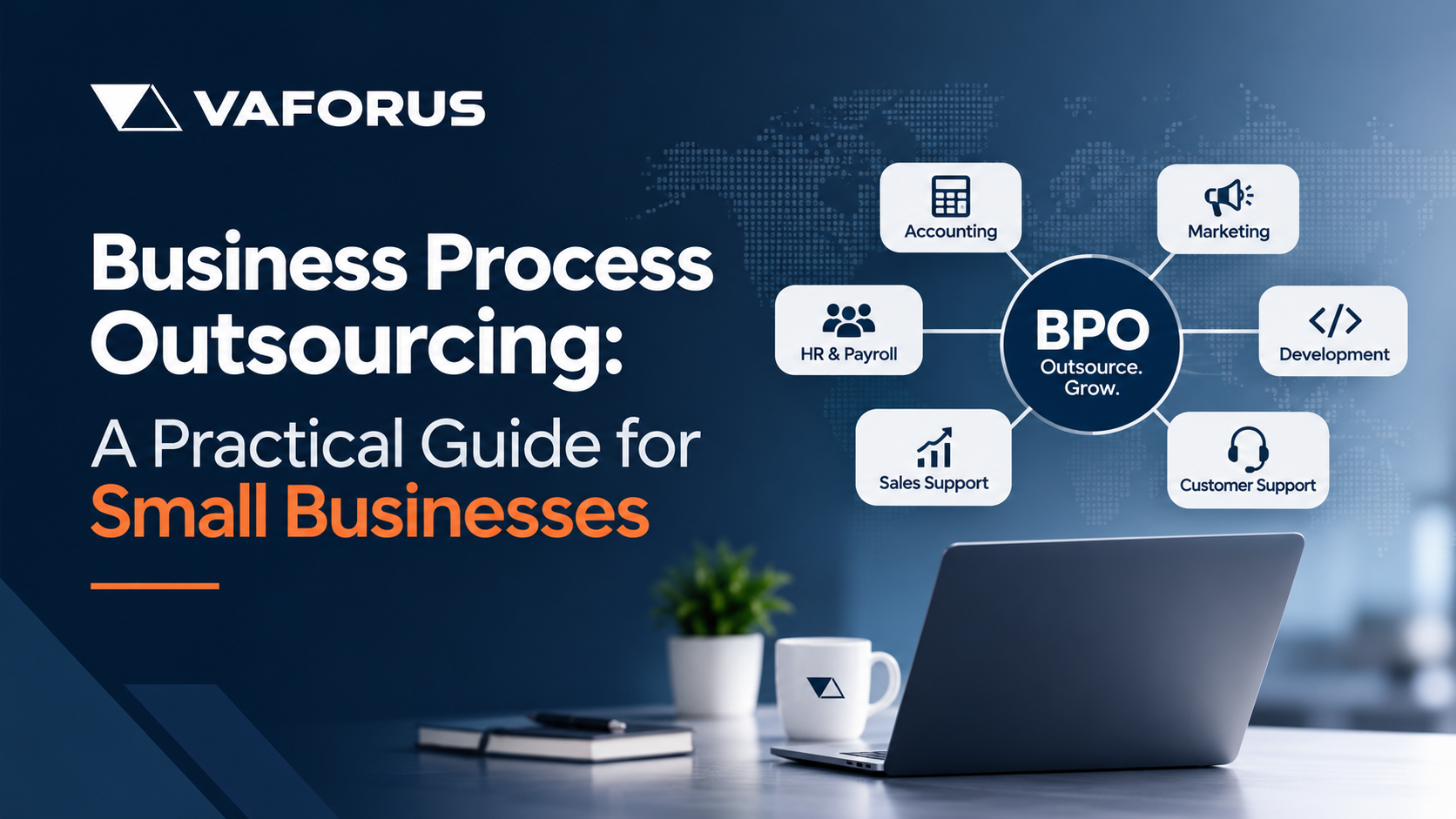
Running a small business means wearing every hat. You answer emails, chase invoices, fix the website and somehow still find time to sell. Business process outsourcing (BPO) is how many owners stop doing it all themselves. Instead of hiring a full-time employee for every job, you hand one function to an outside team that already knows how to do it well. This guide covers what BPO means, which business outsourcing services small companies use most, what it costs, and how to choose a provider you can trust.
What is business process outsourcing?
Business process outsourcing is the practice of hiring an outside company to run a specific business function, such as accounting, marketing or customer support, instead of handling it with your own staff. The provider supplies the people, tools and process. You keep the decisions and the results.
The idea is simple. Some work is essential but not what makes your company special. A third-party provider can do that work faster, often at lower cost, because it does the same job for many clients every day.
BPO is not only for large corporations. Small teams use outsourced business services for exactly the same reason: they need expert output without building a full department.
The main types of BPO services
BPO services usually fall into two groups.
- Front-office: work that touches customers, such as customer support, appointment setting, lead generation and social media.
- Back-office: work customers never see, such as bookkeeping, payroll, HR administration, data entry and IT.
Location is the other split. An onshore provider is in your country. A nearshore provider is in a nearby country and time zone. An offshore provider is farther away, usually with a lower price, though communication takes more planning. Many small businesses work with a global remote team and accept a small overlap in working hours as the trade-off.
Which business functions do small businesses outsource most?
Small businesses most often outsource accounting, IT, digital marketing, HR and customer support. Industry surveys such as Clutch’s put IT and accounting at the top, followed by digital marketing and software development. These tasks repeat, are easy to check for quality, and rarely decide why customers pick you.
Here is what the list looks like in practice:
- Accounting and bookkeeping: daily records, reconciliations, tax filing. Usually the first function owners outsource.
- Payroll, HR and compliance: onboarding, benefits, labor-law paperwork.
- Marketing and content: SEO, blog content, social media, email campaigns and paid ads on Meta and Google.
- Web development: building, fixing and maintaining your website or online store.
- Sales support: lead generation and outbound outreach to book conversations with prospects.
- Digital advertising: Managing and optimizing paid campaigns across Google Ads and Meta Ads to generate leads and sales.
- IT and cybersecurity: helpdesk, monitoring, backups.
- Customer support: phone, chat and email, including after-hours coverage.
- Shipping and fulfillment: warehousing and delivery through a third-party logistics (3PL) company.
If you want outsourcing solutions for small businesses, try the “10 hours a month” test. If you need a specialist skill for only a few hours a month, buying those hours is smarter than hiring someone full-time and hunting for work to fill their week.
Why companies outsource: expertise, focus and cost
Most companies outsource for three reasons.
Expertise. A specialist who serves dozens of clients has seen problems you have not. Hiring that depth in-house means paying for several experts at once.
Focus. Every hour you spend on a spreadsheet is an hour away from the work customers actually pay for. Handing off non-core tasks lets you focus on core goals like product, sales and relationships.
Capacity. Hiring is slow. In a May 2026 survey of 350 small and midsize business executives, G&A Partners found that about 40% had turned down jobs or delayed services because of staff shortages. A provider adds capacity without a long recruiting process.
What does outsourcing really cost?
It costs less than a full-time hire in most cases, but only if you count everything on both sides. Outsourcing replaces a fixed salary with a fee for the work you need. You skip benefits, equipment, workspace, recruiting and idle time.
Those extras are bigger than they look. According to the US Bureau of Labor Statistics, benefits made up about 30% of private employers’ compensation costs in June 2026, roughly $14.07 of the $46.89 spent per hour worked. That is before recruiting, training and management time.
Cheap does not always mean cost-effective, though. Writing briefs, giving access, checking work and fixing mistakes all take your time. A low-priced vendor you have to supervise daily is not saving you money. When comparing business outsourcing services, look at the cost of a finished outcome over 12 to 24 months, including your own management time.
What should stay in-house?
Keep anything that shapes why customers choose you, teaches you about those customers, or carries the promise you make to them. A good rule: outsource work that is repeatable and easy to check, and keep work that builds your knowledge.
A hybrid model often works best. An in-house lead sets the strategy while outside specialists handle design, ads, development or outreach. One principle never changes: you can outsource the task, but not the accountability. If a provider mishandles a customer, you still answer for it.
The risks of outsourced business operations
The main risks are weak data security, loss of control over quality, and dependence on a single vendor.
- Data exposure. Verizon’s 2025 Data Breach Investigations Report found that breaches involving a third party doubled from 15% to 30%. Give each provider only the access it needs.
- Quality drift. A slow or careless provider can cost you customers even when the function is “non-core.”
- Lock-in. If nobody inside your company can explain the process or recover the data, you are exposed.
- Freelancer sprawl. Hiring five separate contractors often turns the owner into a full-time project manager.
The fix is simple: name one internal owner, define what “good” looks like, and spot-check the work before a customer does.
How to choose a managed outsourcing services provider
Managed outsourcing services means the provider runs a function for you on an ongoing basis, with someone accountable for the results, rather than handing you loose tasks. Because you hand over more, vetting matters more.
Ask:
- Do they understand your industry and customers?
- Is pricing transparent, and what is excluded?
- Who supervises the work, and who do I speak to when something goes wrong?
- How do they protect data, and how is access removed when we finish?
- Can I take my files, accounts and processes with me if I leave?
- Can we start with one function before committing to more?
Where Vaforus fits
Vaforus is an outsourcing partner for businesses that have more work than hours but do not want to build another full-time team. We cover web development, SEO and blog content, lead generation and outbound, email marketing, social media, and Meta and Google Ads.
What makes it different from hiring freelancers is how the work is run. Each project is supervised by the founder, so you deal with one accountable team instead of juggling several contractors. The process is straightforward: a discovery call, a defined scope, a team built around your project, then managed execution. You can start with a single function and add more as results come in.
If you are weighing outsourcing solutions for small businesses and want to see whether it fits your workload, book a discovery call with Vaforus.
FAQs
What is business process outsourcing?
Business process outsourcing (BPO) is when a company hires an outside provider to run a specific business function, such as accounting, customer support or marketing. The provider manages the people and tools. The company keeps control of strategy and results.
Why do companies outsource?
Companies outsource to reduce costs, access specialist skills and free their team to focus on core work. Many also outsource to add capacity quickly during growth or when hiring is difficult.
How does outsourcing reduce costs?
Outsourcing replaces a fixed salary, benefits, recruiting and training with a fee for work delivered. Businesses also avoid equipment and workspace costs. Savings shrink if the owner spends a lot of time managing the provider.
What are 10 examples of outsourcing?
Ten common examples are bookkeeping, payroll, tax preparation, customer support, IT helpdesk, cybersecurity, digital marketing, web development, lead generation and shipping and fulfillment.
What services do small businesses need the most?
Small businesses most often need accounting, marketing, IT support and customer service. These tasks repeat often, need specialist skills, and rarely set a company apart from competitors.
What is the difference between outsourcing and hiring freelancers?
Freelancers are individuals you manage yourself. Managed outsourcing means a provider takes responsibility for a whole function and its results, so you manage less and rely on one accountable team.
Conclusion
Business process outsourcing is not a way to avoid work. It is a way to put the right work in the right hands. Hand off the repeatable, easy-to-check functions, keep what shapes your customer relationships, and choose a provider you can verify. For most small teams, the best outsourcing solution starts with one function and one clear goal, then grows from there.